01 · Mapping & strategy
- Identify the processes where AI saves the most time and money
- A roadmap aligned with business goals
- Initiatives prioritized by impact and effort
 aiforwork.ing
Enterprise adoption 360°
In almost every organization, employees already run AI tools and agents nobody approved, simply because it helps. The question is no longer whether AI comes in, but whether it comes in through the front door or the back one. We, myself and our implementation team, guide organizations through the full process: mapping, choosing a secure environment, actually building the agents and automations, training the people, and measurement you can show leadership.
It depends on scope, and the sequence usually looks like this: mapping and strategy take a few weeks, and before the first line of code we settle data classification, data location and system connections with IT and information security. The first agents run within the first month, and their metrics are defined before building starts. Department training spreads out at the organization's pace, until every team can run and maintain its own agents. We build and measure as we go, so the first value arrives well before the end of the process.
We usually start with one or two workshops, and from there decide together whether to continue into full adoption. These are the three entry points:
Usually 2 sessions of 3 hours, and every participant leaves with an agent working on a real process from their own job. Pick from the workshops by department, or open with the AI Champions Course (Hebrew) for your organization's AI leaders.
The process described on this page: mapping, a secure environment, building the agents and automations, training the people, and measurement. It ends with agents running on your systems, each with an owner and documentation.
An embedded Forward Deployed Engineer joins you one or two full days a week and works in two-week sprints. Every sprint closes with a working deliverable, and the knowledge stays with you.
An agent is a digital employee: it has access to systems, it performs actions, and it can make mistakes. And yet most organizations still have no written rules for what it may do. With us, governance is part of the build, not a document written afterwards:
The EU AI Act requires organizations in its scope to take measures to support AI literacy among those operating AI on their behalf (Article 4, in force since 2 Feb 2025; since July 2026 an obligation of effort, with no required level). Transparency obligations (Article 50) apply from 2 Aug 2026. If your activity or your systems' outputs reach the EU, it is worth checking whether this applies to you. Training is no longer just "nice to have". This overview is professional, not legal advice.
Every organization sits at a different point on the security axis. We help you choose right:
Adoption usually fails not because of the technology but because of a skills gap: tools get purchased, and people keep working as before. That is why every adoption we run includes a tailored training program. The Champions course plus eight more tracks, one for every department (workshop pages are in Hebrew):

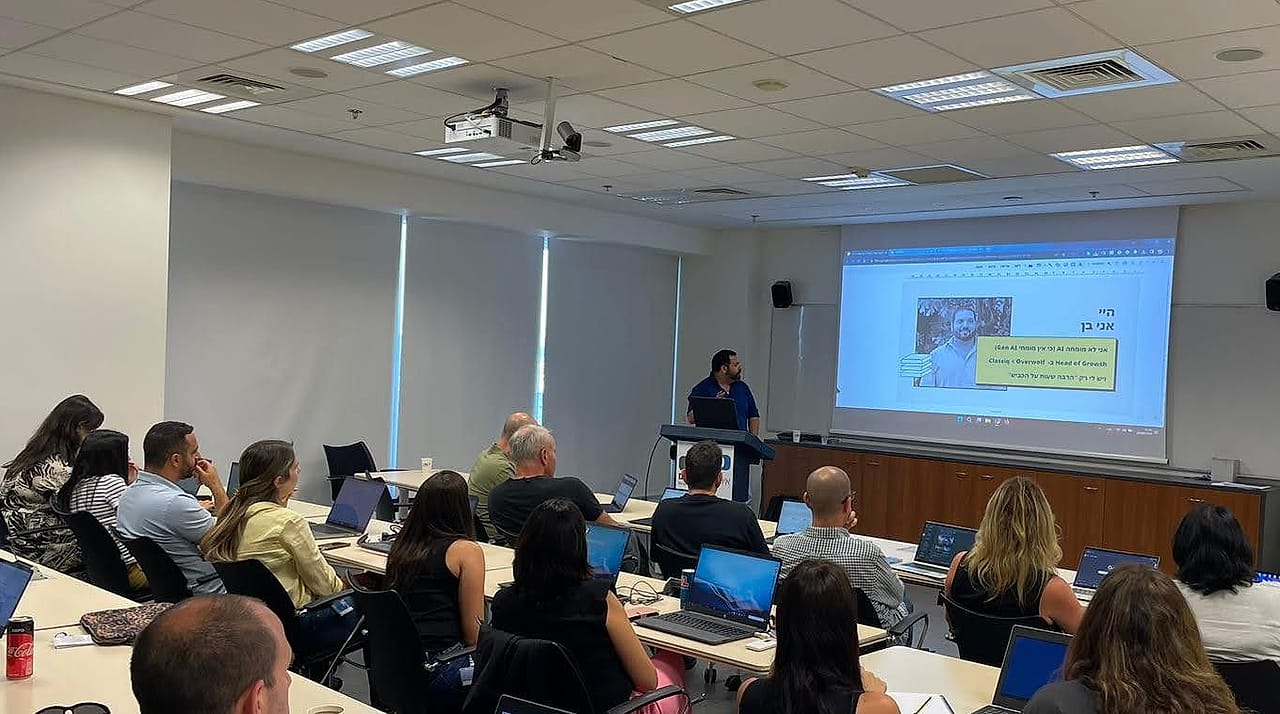
Ben Rotenberg delivered an inspiring generative AI workshop that made these tools useful and part of the daily routine for me and for Isracard's employees. Despite our regular use of AI tools, Ben managed to show us how to meaningfully improve and streamline our work. The workshop received positive feedback from all participants and was an important milestone in our training program.
It depends on scope: mapping and strategy usually take a few weeks, first agents run within the first month, and department training spreads out at the organization's pace. The guiding principle is an early running deliverable: we don't wait for the end of the process to see value, we build and measure as we go.
Enterprise editions are the vendor's managed cloud service, with a commitment that data is not used for training and with organizational permission management. On-premises deployment runs the models on your own infrastructure with no outbound connection, and suits organizations with maximum sensitivity. Between the two extremes there are private clouds and closed API-based platforms.
If your activity or your systems' outputs reach the European Union, possibly yes: Article 4 of the EU AI Act, in force since February 2025, requires taking measures to support AI literacy among those operating AI systems on the organization's behalf. Since the amendment that took effect in July 2026, this is an obligation of effort, with no required level. Even without direct applicability, structured training is the basis for any enforceable usage policy. Verify applicability with legal counsel. Last reviewed: October 2026.
Not by licenses purchased but by work done: cycle time of processes the agents run, error rate before and after, actual usage over time, and employee hours freed for value work. Metrics are defined before building, so after the rollout leadership has numbers, not feelings.
That is the reality in most organizations: employees already run tools and agents nobody approved, simply because it helps them work. The effective path is not blanket blocking but an orderly alternative: an approved environment at least as convenient as the private tool, a clear policy, and training that explains what is allowed, what is not, and why.
Start with data classification: decide which data may go into which tool, and what never leaves the organization. Choose the environment by sensitivity level, from Enterprise editions to on-premises deployment with no outbound connection. Every agent gets access only to what its process requires, human approval is required at predefined points, and every action is logged in an audit trail. All of this is settled with IT and information security before the first line of code.
We guide the adoption together with the organization's compliance, legal counsel and information security. Regulatory and legal questions are decided on your side, and we bring the operational side: an environment that fits the sensitivity level, up to a private cloud or full on-premises deployment, predefined rules for what data enters each process, least privilege for every agent, and an audit trail that can reconstruct and prove every action. The organizations we have worked with include banks and financial institutions.
A workshop trains the people and ends with a first working agent, usually after 2 sessions of 3 hours. Adoption is a full organizational process: process mapping, choosing a secure environment, building agents connected to the organization's systems, governance and permissions, and measurement over time. The workshop is usually the entry gate to adoption, and training itself is one of the four stages of adoption.
A short intro call, an initial needs mapping, and a proposal tailored to your organization.